On review aggregator website Rotten Tomatoes, the film has a 100% approval rating based on 23 reviews, with an average ranking of 7.7/10. The site's critical consensus reads, "As visually dazzling as it is thought-provoking, Fantastic Fungi sets out to make audiences see mushrooms differently -- and brilliantly succeeds."[4] On Metacritic, the film has a score of 70 out of a 100 by 8 reviews, indicating "generally favorable reviews".[5]
Critics praised Schwartzberg's time-lapse cinematography. Some critics found the narration unnecessary.[6][7]
Josh Kupecki of The Austin Chronicle said "visual affectations aside, Fantastic Fungi is an engaging look at the scope of an organism that is so much more than a pizza topping or an ingredient in beef stroganoff".[8] Andrew Pulver of The Guardian wrote "With it spectacular footage of growth and decay and impassioned speeches about the magic of mushrooms, this documentary is a treat for the eye and ear".[9] Rex Reed of The New York Observer called the documentary "charming",[10] while John DeFore of The Hollywood Reporter called the film an "[e]ye-opening eye candy".[6]
According to Robert Abele of the Los Angeles Times "it edges a little too close to being a commercial, but that's a nitpick when the totality of Fantastic Fungi is so entertaining, informative and appealingly hopeful about the hard-working cure-all for our ailing world lying beneath our feet".[11]
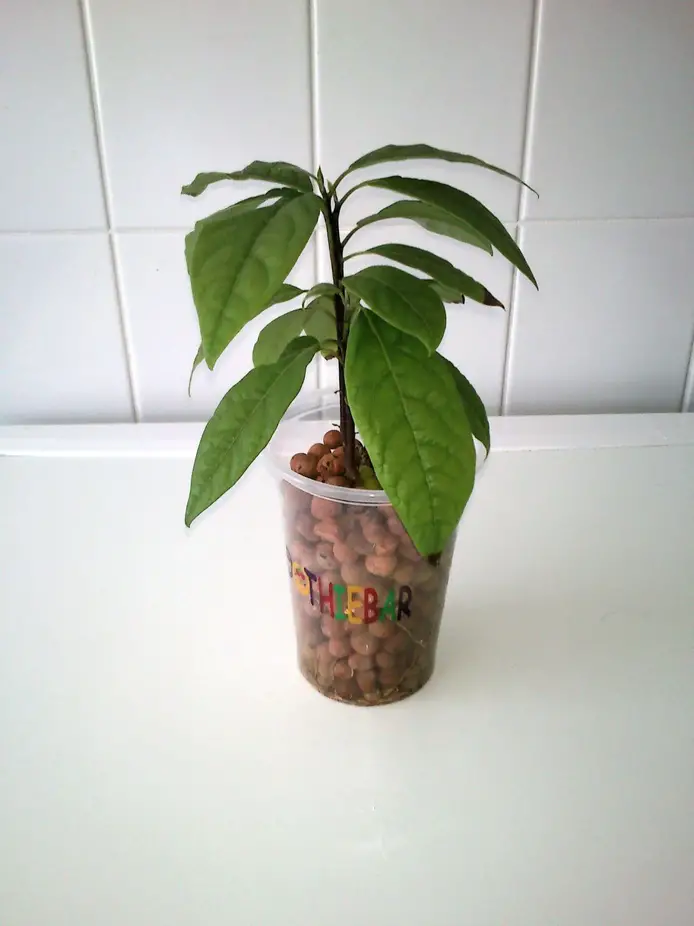
Hydroponic avocado has been proven feasible countless times, from a surprisingly fun houseplant to a clever way to grow vegetables in areas threatened by extreme weather.
This soilless cultivation technique has some inherent limitations, especially when it comes to a large, fruit-bearing tree that typically requires well-aerated soils like avocado.
But there is still plenty of merit for growing avocados without soil, either in a commercial or a DIY hydroponic system. How To Start An Avocado Tree Hydroponically
The Ultimate Guide to Hydroponic Gardening 1) Tools & How to set up your garden 2) Different hydroponic systems 3) Best plants to grow hydroponically
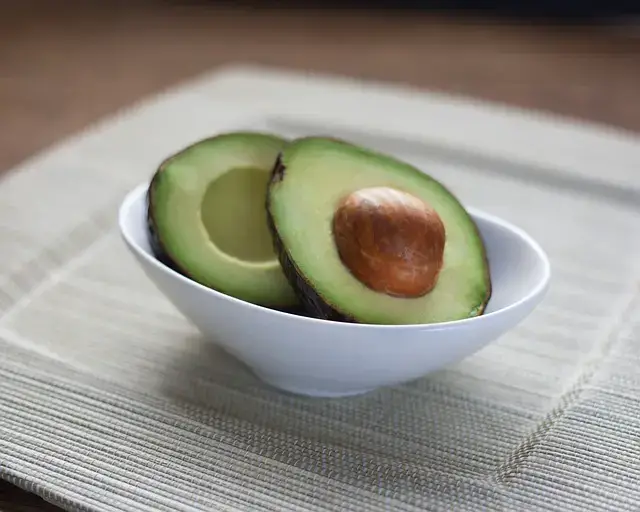
An advantage of avocado is that you don’t need to purchase expensive genetically engineered seeds. A leftover pit is already enough for you to start a small gardening project. Prepare the seed
First of all, you will need to coax this hard seed to crack and sprout. While the sprouting process is simple and similar for different cultivars, it could be a long haul and take several weeks.
You have to pay close attention to an essential requirement for optimum sprouting potential: the pit should come from ripe avocado fruits, and it shouldn’t be damaged or spoiled in any way.
Remove the seed from the avocado and gently rinse it in lukewarm water to get rid of any remaining flesh.
When there are still stubborn bits of residue sticking to it, soak the seed for 10 or so minutes so the flesh could soften up. Don’t scrub hard and damage the brown covering of the seed.
Let the seed dry on paper towels for 2 days, then peel away the aril.
Note: Do everything with care, as a spoiled pit will have little chance of sprouting and growing into an avocado tree.
Figure out which end is the bottom and which is the top of your avocado pit. The end going up is where the stem will break and emerge, while the roots will grow from the bottom of the pit.
Some pits may shape like a sphere, whereas others are slightly oblong. But most of the time, the flatter end is the bottom end, and the top is slightly pointier.
The way the avocado seed sits inside the fruit could also give you an essential clue since the top end is near the fruit’s stem end.
Pierce the seed with some toothpicks
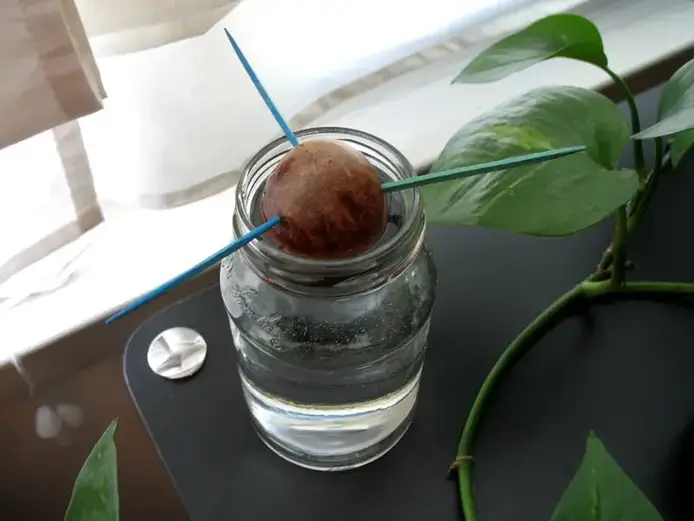
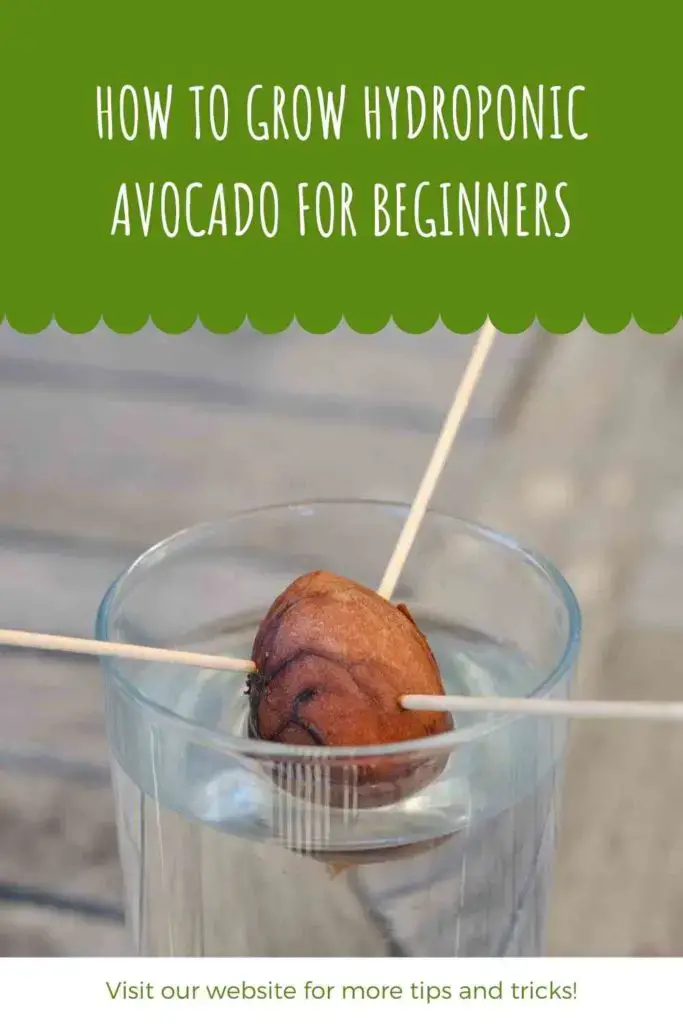
Grab 3 or 4 toothpicks and insert them around the outer edge of the pit to suspend them in the glass of water.
Push the toothpicks firmly into the seed, far enough to support its weight. Angle them slightly downward with equal distance between them. They have to be perpendicular to the seed when it’s held upright.
Alternative method
Hanging an avocado seed using toothpicks is the most common method. But it’s a little tricky for beginners, who may even damage the seed after many failed attempts.
Gardeners also need to check the seed regularly to ensure the toothpicks are still intact and keep the seed partially submerged.
A small plastic device called an “avocado tree growing kit” or “avocado seed holder.” It’s a floating bowl with a hole in the middle, which is large enough to keep the seed sufficiently wet all the time.
You would have to order one bowl like that for each avocado seed, and the cost could add up quickly. But it’s still an excellent choice for novice gardeners who have never grown avocado from a pit before.
Position the seed in water
The whole point of the seedling phase is to keep the bottom of the avocado seed moist at all times.
Hang the seed on top of a small-mouthed jar or a regular drinking glass using the toothpicks as a scaffold. Fill water into this container.
The toothpicks should rest on the container’s rim, and water should cover about one-quarter of the avocado seed.
Repeat this step for each seed, ensuring that each has its glass and the bottom end is submerged correctly.
Place the seed in sunlight and wait
Place the containers in a bright and warm spot that isn’t prone to direct sunlight.
The sprouting process could take weeks, and a substantial amount of water could evaporate during the period. Check the containers and replenish the water over time as needed. You will also want to change the water when it becomes cloudy.
A small root should emerge from the bottom after a few weeks. A shoot should appear at the top of the seed not much later after that point as well. This small shoot is where leaves will form and grow. Maintain the water level to help the roots survive.
Discard any seeds that don’t crack and sprout within three months. Replace them with fresh seeds in the same containers.
When the stems reach about 6 inches tall, cut them in half. The purpose is to make the avocado plant branch and bushy.
When they grow to 6 inches again, transplant them into a proper hydroponic system so you can have more control over growing conditions.
How to Select Avocado Varieties for Hydroponics?
Some popular commercial avocado varieties can be transferred into and grown in a hydroponic system, including Lila, Brazos Belle, Bacon, Mexicola Grande, Lula, and Hass (the most popular cultivar of avocado).
If you intend to grow avocado indoors in the long term, consider dwarf varieties like Little Cado, Reed, Gwen, Lamb Hass, and Wurtz. These dwarf avocado trees usually require only 10 to 15 feet of vertical space.
What Hydroponics System Works Best for Avocado?
Deep water culture (DWC) is the most suitable method among popular hydroponic systems for optimal growth.
It doesn’t require costly investment like commercial products and can provide more water for big trees like avocados than wick systems. DWC is also an easy method to pick up, even for those just getting the first taste of hydroponic gardening.
There are many off-the-shelf systems from different manufacturers that can grow a hydroponic avocado tree from seed. Many DIYers have successfully built a deep water culture system from household items, such as a broken shop.
Ideal Conditions for Hydroponic Avocado
Light
Avocado trees thrive in intense, bright light. They will survive some shade, but for the best results, put your hydroponic avocado in the sunniest spot you have.
Remember that this only applies after the roots and first leaves have emerged from the seed. Keep the seed out of direct sunlight until it sprouts completely.
Water
Bear in mind that avocados require a lot of water (a healthy tree may need 3 times more water than apples, for example.) Replenish it if the water level isn’t enough to submerge the roots.
Regularly clean the reservoir or bucket DWC as well to make sure there is no salt formation. Temperature
As a subtropical plant, avocados prefer warm temperatures, ideally for most 68 to 75°F. Some cold-hardy varieties can survive 20°F and colder climates with some leaf damage and slow fruit growth. pH
Avocado trees grow best at 5-7pH. They are sensitive to and will suffer when the pH level goes beyond 7, compromising zinc and iron uptake.
Using test strips or digital pH meters to detect any problem with the pH for avocado trees. Commercial “pH up” and “pH down” products are the easiest way to control pH levels in a simple deep water culture system.
Digital pH controllers are more expensive, but they offer more accurate and reliable results. Fertilizer
Avocados grow well with fertilizers made for citrus trees. Nitrogen is one of the most critical nutrients for avocados, but too much of it can burn the shallow roots. Source
The nitrogen, phosphorus, and potassium (N-P-K) avocado fertilizer ratio should be 2:1:1. Always prefer using hydroponic nutrients over regular soil fertilizers. Plant Spacing
Most mature avocado trees need a lot of vertical space, except dwarf varieties. Be prepared to relocate the containers every few months to accommodate the grown branches and leaves.
How Long Does It Take For Avocados to Grow?
An avocado pit usually needs from 2 to 6 weeks to sprout. After that, it may take another 10 or 15 years to bear fruit.
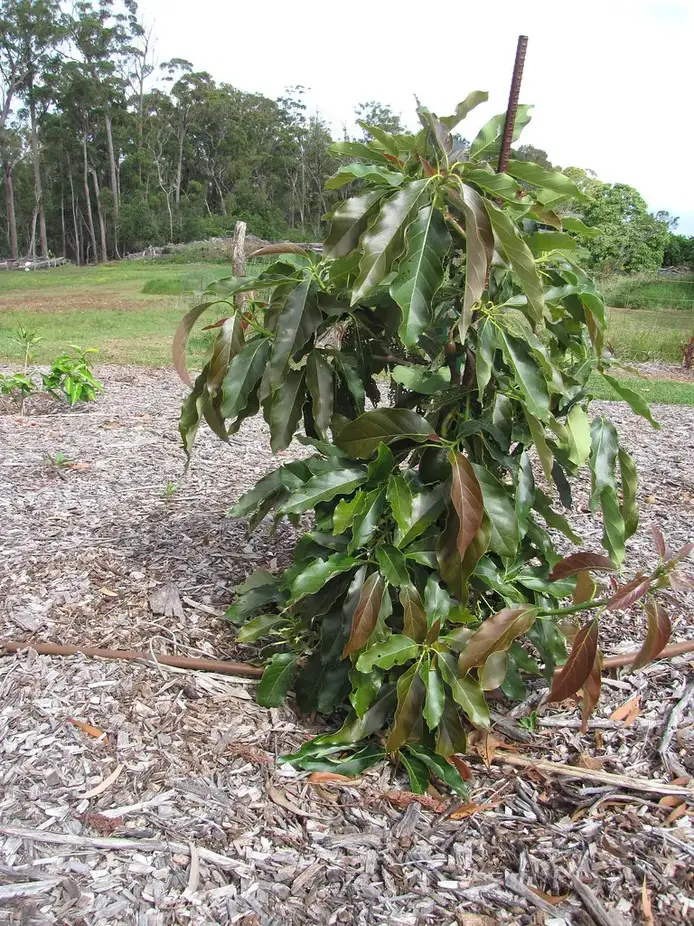
Hass Avocados, the most common cultivar, typically grow into a height of 15-20 feet after 3 or 4 years. But some varieties grow much faster, reaching 40 or even 60 feet within the same time. How Often Do Avocado Trees Produce Fruit?
Growing avocado from a pit (non-grafted), you may have to wait for 10 years, or even 15 years, before the tree begins to bear fruit.
Many cultivars also yield a crop of fruit every other year. This “biennial fruiting” means producing a heavy set of fruit (up to 200 or 300 per tree) one year and a much lighter crop in the successive year.
Frequently Ask Questions (FAQ)
Can you grow avocados in just water?
Growing avocados in just water is not recommended. It would take weeks or even months of careful, light watering to get even one seed to germinate. That high level of care required makes it impractical for most people.
What temperature is too hot for avocado trees?
Avocado trees, like most other fruit trees, need 70°F – 80°F temperatures to grow properly. The ideal temperature for these tropical plants is about 76.5°F.
The plant’s root system will adapt to the surrounding climate (elevation and/or latitude), but the optimal temperature range is 65°- 90° F (18°-32 °C) for avocado trees’ flowers and fruit to mature properly.
The rule of thumb is you should leave it at least 5 degrees cooler than your nighttime temperature.
The Ultimate Guide to Hydroponic Gardening 1) Tools & How to set up your garden 2) Different hydroponic systems 3) Best plants to grow hydroponically
GET MY EBOOK We respect your email inbox and will never spam! Conclusion
Commercially, growing avocado hydroponically is less popular than traditional farming, but there are many reasons why gardeners, even beginners, try this soilless method.
Jill Sandy I am a sustainable focus gardener. I love decorating my home backyard with beautiful landscape design and creative garden care techniques I develop myself.
The term waste describes materials or products that are no longer of use. In a linear economy, it accumulates as an undesired by-product of economic activity. Waste and environmental hazards are commonplace throughout the current industrialized food system. Although some initiatives have been aiming to reduce waste toward the end stage – for example, by changing consumer perceptions and matching excess supply with demand – significant progress needs to be made during food production. Where do we start?
Redesigning production and consumption
One idea that has been growing in both research and practice is thecircular economy, which sees value in “waste” flows and re-routes them back into the economic process. A striking example of a circular-economy business model in action is aquaponics, which combines elements of aquaculture (fish farming) and hydroponics (plant farming with controlled systems). It allows a single producer to sustainably grow produce and raise fish within the local community.
While traditional aquaculture is performed in structures within a natural environment, aquaponics adopts the circular-symbiosis approach, where the biological waste of a fish farm is harmonised to be the biological food for the production of plants such as herbs, salads and tomatoes. Compared to traditional industrial farming operations, where circularity might be added at the end (for example, compost), aquaponics employs a circular production design by leveraging nature’s template. This is a balancing act to technologically control two separate but dependent biological systems, which improves the productivity of the physical space – in this case an urban environment – while reducing environmental impacts.
Aquaponic firms leading the way include ECF Farmsystems and Stadtfarm in Berlin, BIGH Farm in Anderlecht, Urban Smart Farm in Gent and Bioaqua Farm in Blackford, United Kingdom. They’re among a growing number of urban-farming pioneers that challenge the way we perceive, produce, and purchase our food.
A better solution
How these benefits are derived can best be understood by a comparison with traditional aquaculture systems. In these cases, fish produces high levels of nitrates and phosphorus, which must be purged from the system and replaced with fresh water to maintain healthy living conditions. However, by flushing this nutrient-rich fish wastewater into the environment, ecosystems may be damaged by eutrophication. In urban environments, it imposes costs for treatment through municipal sewage systems. Furthermore, these same nutrients are required for plant cultivation – and in the case of nitrates – they are commonly derived in an industrial process that requires significant quantities of methane gas, must be shipped to the farm, and are often (over)applied to crops.
An aquaponics system takes the would-be waste output of highly nutrient water and delivers it directly to plants, cleaning it and reducing this dependence on added fertilizer. The water is maintained in the system, continuously circulates and is cleaned mechanically and biologically. It effectively reduces water needs –advanced aquaponics systems achieve up to 90% higher water efficiency than traditional field farming – as well as reducing the dependency on fossil fuel for transportation, because production is close to the markets for the final food products.
“Food miles” are not only a contributor to GHG-emissions but they are also part of a phenomenon of anonymization of food production, detaching the consumer from its source. Sustainable urban farming through aquaponics thus brings food production closer to its consumers. While urban farming is primarily a source of plant-based fibre, vitamins and minerals, aquaponics is able to deliver the missing dietary link, animal protein. Indeed, aquaculture is far more efficient and practical in this respect than other forms of livestock breeding in urban environments. Furthermore, it has the added social benefit of bringing advanced farming jobs to urban areas.
Challenges of aquaponics
Thus far, aquaponics businesses operate in a vague policy environment that falls under both aquaculture and agriculture, resulting in a web of bureaucracy. At the EU level, aquaponics is not regulated as a distinct sector, and regulations are therefore less than ideal. This filters down to the local level, where major challenges faced by aquaponic operations concerning zoning, planning and permissioning. Surprisingly, ECF had struggled to have its greenhouses approved on what is currently an industrial sector – there are rigid definitions of what industry, agriculture and food production are, limiting the integration of such innovative concepts.
Furthermore, to assess the sustainability of any process, one must consider all inputs and outputs. For aquaponics, while there is potential for significant environmental benefits, a major challenge is obtaining sustainable fish feed. Most is derived from soy or animal products with significant environmental impacts themselves. Furthermore, some feed components aren’t ones that the fish species would find in its natural environment and thus aren’t needed. Developments in insect-based feedstock might be a solution to many environmental concerns.
Moving beyond a niche market
Despite these challenges, ECF and other aquaponics advocates, believing in substantial benefits for society, continue to expand and seek out regulatory changes, signalling hope for the new market.
The concept of aquaponics provides insights into how circularity could be approached and ease the challenges of global population growth – with a need for sustainable food, free of herbicides, pesticides, hormones, antibiotics, and microplastics, that considers urbanization, food transportation, clean water scarcity, and environmental hazards related to traditional farming, eutrophication and carbon emissions in particular. Beyond these benefits, urban farming may also help green our concrete jungles and have further environmental and psychological benefits.
Farming with Nature's Elements of Earth, Water, Wind and Fire...and Microbes
8-11PM Yoshikazu Kawaguchi True Natural Farming that makes sustainability possible:
In the future, as well as in the present, natural farming will be indispensable for people to live happily, and be asked how to live sincerely as a human being.
=====
December 4th
2:30PM Walter Jehne
The soil-microbial-root interface in the evolution, resilience and future of life on land
4PM Joshua Chua
Fruit-Veggie-Poultry-Fish Cycling Garden for Food Security
5:15PM John Bosco
Natural Poultry and Piggery to Feed the Village
6:30PM Subhash Palekar
Natural Farming and Natural Way of Life: Back to Nature
-----
8-11PM Round Table Discussion
The focus of this event goes far beyond Nature Farming as a series of recipes, instead bringing in natural philosophy and going back to the traditional roots of farming.
As the world gets increasingly connected by technology, it is also causing cultural amnesia as homogenous forces of consumerism cause the domesticated and industrialized to forget how to live harmoniously in their own ecosystems.
Fermentation as an art form, has largely been forgotten due to the convenience of electricity, and so human microbiomes have suffered.
Microbial based agriculture can help heal the soil, fostering greater ability for human health, empowering us all through food sovereignty.
Nature Farming as a spiritual worldview allows us to remember we are part of the natural world and can foster diversity in our bioregions.
Join Gil Carandang, Subhash Palekar, Yoshikazu Kawaguchi, Rei Yoon, Steve Diver, Joanna Campe, Paul Olivier, Lance Hancherow, John Mwangi Ndungu, and Peter Jackson for discussions related to Nature Farming, Agroecology, Remineralization, Closed Loop Waste Transformation, Fermentation, Biochar, Microbially Augmented Agriculture, and Food Sovereignty. More details at www.cascadiannaturalfarming.org




 Paul Wolf
 Sylvie Geisendorf
 Rendering of the ECF Farmsystems facility in Berlin, Germany. Author provided