Sunday, July 18, 2021

How to Grow Microgreens Without Soil | Balcony Garden Web

How to Grow Microgreens Without Soil | Balcony Garden Web

How to Grow Microgreens Without Soil


Loaded with proteins and vitamins, these tiny, tender plants are both easy to grow and good for health! Learn How to Grow Microgreens Without Soil!

Microgreens are loaded with vitamins, lutein, and several other essential nutrients. They are widely used in the preparation of soups, salads, and sandwiches. For a constant, fresh supply, you can grow them easily at home! Let’s have a look at How to Grow Microgreens Without Soil!
Check out our article on the best microgreens to grow here!
What are Hydroponic Microgreens?


Hydroponics is a procedure of growing plants without soil. This eliminates the fuss of handling the soil, and the plants absorb oxygen and nutrients from the water. For good results, add fertilizer to make a nutrient-rich solution for the roots.

Other growing methods like substrates can also be used to assist roots in a hydroponic system. Other mediums include hemp mats, coconut coir, clay pebbles, rock wool, and vermiculite, though some hydroponic systems don’t need a growing medium at all.


Volume 0%


Next
Stay
Popular Microgreens to Grow Hydroponically


Amaranth
Basil
Kale
Broccoli
Mustard
Tatsoi
Orach
Borage
Beet
Parsley
Peas
Red pak choi
Swiss chard
Growing Microgreens Hydroponically at Home


It is essential to have the right pH of water. Microgreens do best in the pH range of 5.5-6.5. Always go for filtered water.
Use 10 x 20 plastic trays with hydroponic growing pads. Pour the water and ensure that the pads are properly wet with no dry spots. Lay them flat for seeding.
Alternatively, you can also use paper towels in place of growing pads. Fold the towel several times to make a thick layer.
Spread seeds evenly. If you are looking forward to growing a denser crop, you can use three tablespoons of seeds. This measurement is perfect for growing microgreens like arugula, broccoli, mizuna, and radish.
Take a mister and mist the seeds evenly with 12-15 sprays. Now, take an empty, dark-colored tray of the same size and spray the inside to mist it evenly and put it upside down on the top of the growing tray. This will provide humidity and moisture, while also keeping the seeds sheltered from excessive light.
Place the tray at a warm location where it gets temperature between 65-85 F (18-30 C) or around it.
Using a spray bottle, mist the tray every 10-12 hours. Do not water the tray.
After 4-5 days, the seeds will sprout. Uncover the tray and keep it at a spot that gets direct sunlight for 3-4 hours. Also, rotate the dish, so it gets even light.
Check the water level by pressing your finger at the pad. Pour till it covers the base of the sprouts and soaks up the pad. At this point, stop using the sprayer bottle.
Most of the microgreens will be ready for harvest in 10-12 days. Some crops can be harvested in 7 days as well!
Harvest them in the late evening or early morning as this keeps them fresh and crisp.
Here’s how you can grow strawberries hydroponically!
Benefits of Growing Microgreens Hydroponically


Growing microgreens without soil need far lesser water as compared to planting in the soil. Also, you can re-use the water in the hydroponic system.
Grow them all year round, anywhere at your home! Whether its garage, basement, patio, or a balcony!
Some microgreen varieties like wheatgrass, kohlrabi, and kale grow well hydroponically and produce better crops compared to growing in the soil.
Check out our article on hydroponic vertical garden ideas to grow food here!


Tuesday, July 6, 2021

Irrigation Drip Kit,25M Kit Drip Irrigation System Garden Automatic Irrigation Micro Flow Drip Plant Garden Hose Watering Kits for Flower Bed,Lawn,Patio Plants : Amazon.com.au: Garden

Irrigation Drip Kit,25M Kit Drip Irrigation System Garden Automatic Irrigation Micro Flow Drip Plant Garden Hose Watering Kits for Flower Bed,Lawn,Patio Plants : Amazon.com.au: Garden


$35.99
$2.00 delivery: 15 - 22 July


Roll over image to zoom in


Irrigation Drip Kit,25M Kit Drip Irrigation System Garden Automatic Irrigation Micro Flow Drip Plant Garden Hose Watering Kits for Flower Bed,Lawn,Patio Plants
Brand: N/Z

3.6 out of 5 stars 4 ratings


Price: $35.99


【Complete Drip Irrigation Kit】 This flowerbed drip irrigation kit includes all components from a faucet or garden hose start system and can be expanded to cover an irrigation area of ​​up to 20-25 square meters, eliminating the need for manual watering.
【Save Both Water and Money】 Plant drip irrigation systems can save up to 70% of water. The precision watering system provides the right amount of water where your plants need it slowly and precisely in the root area.
【Easy to Install】 Install the irrigation system in just minutes. You do not have to dig or whistle. You can start watering your plants immediately.
【Pay Attention to Water Pressure】 Water pressure and other factors affect the water output of the dripper. If the water pressure is too low, the water output at the end of the drip irrigation kit would be poor.
【Applicable Widely】 The automatic irrigation kit is suitable for any place you want, such as swimming pool balcony cooling plant watering, vegetable garden, lawn atomization, fog cooling system, dust removal, garden humidification.


Sponsored


Product details

Package Dimensions ‏ : ‎ 23 x 15 x 7 cm; 850 Grams
Date First Available ‏ : ‎ 7 January 2021
Manufacturer ‏ : ‎ N/Z
ASIN ‏ : ‎ B08SC5YTYK
Best Sellers Rank: 5,633 in Garden (See Top 100 in Garden)
30 in Automatic Drip Irrigation Kits
Customer Reviews:
3.6 out of 5 stars 4 ratings


Frequently bought together


+


Total Price:$75.98Add both to Cart

These items are shipped from and sold by different sellers.
Show details


This item: Irrigation Drip Kit,25M Kit Drip Irrigation System Garden Automatic Irrigation Micro Flow Drip Plant Garden Hose Watering Kits for Flower Bed,Lawn,Patio Plants
$35.99


Rainpoint Water Timer Smart Irrigation Hose Timer 2021 New
$39.99


Products related to this item
Sponsored
Page 1 of 68Page 1 of 68
Previous page of related Sponsored Products


50M Hose Garden Irrigation System with Timer Plant Watering DI...

$53.99

Garden Plant Drip Kit, Irrigation System with Water Timer 50M ...

$45.99

108 Sites 12 Pipes Hydroponic Grow Kit, Hydroponic Planting Eq...

2
$152.89

50M Hose Garden Irrigation System with Timer Plant Watering DI...

2
$27.99

Drip Irrigation Kit with 131.23ft Hose, Garden Irrigation Syst...

1
$28.89
Next page of related Sponsored Products


Have a question?

Find answers in product info, Q&As, reviews


Product description

Complete Drip Irrigation Kit: This flowerbed drip irrigation kit includes all components from a faucet or garden hose start system and can be expanded to cover an irrigation area of ​​up to 20-25 square meters, eliminating the need for manual watering.

1 / 4-inch blank distribution pipe: 
sturdy, flexible pipes that are easy to deploy and can be staked in gardens, flower beds, groundcovers or other landscaped areas. 
Used to branch out of a 1/2 inch pipe [12 mm] to convey water to a 1/4 inch [6mm]  launcher pipe or launcher device.

Save both water and money: Plant drip irrigation systems can save up to 70% of water. The precision watering system provides the right amount of water where your plants need it slowly and precisely in the root area.

Fully water-customized – the water flow of each drip head can be individually adjusted so that each plant can receive customized watering according to its exact needs. Just rotate the drip head counterclockwise to increase the drip flow, or turn the drip clockwise to decrease the flow. Ideal for decks, terraces, greenhouses, gardens, lawns, etc.

Tip: Soak the end of the tube in hot water for one minute, and then push the joint, the tube will tighten after cooling down.

product features:

Material: ABS

include:

1.25m tube 12 mm

2.Universal connector, quick connector, nipple connector, raw material belt, simple puncher each

3. 20 orange sprays

4.20 flat mouth tees

5.20 positive tees

6. Little Red Riding Hood dripper 15

7. 40 single barbs

8.Ground 15

9. Black 8 holes to insert 5

The package includes:

A watering system

Saturday, July 3, 2021

What is a Media Based Aquaponics System? | Go Green Aquaponics

What is a Media Based Aquaponics System? | Go Green Aquaponics

What Is A Media Based Aquaponics System?

A media-based aquaponics system, also called flood and drain, is the most common small-scale aquaponics system popular with do-it-yourself (DIY) backyard home systems. Media-based systems designs are simple and efficient with space and have a low initial cost suitable for beginners in aquaponics.

How Media Based Aquaponics Systems Work

The media-based consists of a grow bed filled with grow media (expanded clay pebbles, gravel, lava rock) into which the vegetables are planted. The water from the fish tank is pumped or flows by gravity into the grow beds so that the plants can access the nutrients. The grow media are porous to allow them to hold the water longer for more efficient nutrient uptake and filter out the water to prevent solids materials and other organisms from entering the fish tank.

The grow bed serves as both the mechanical and biological filter and location for mineralization. The grow beds also host the colony of nitrifying bacteria and provide a place for the plants to grow.

On exiting the grow beds, the water flows to the sump tank by gravity. At this point, the water is clean and free of solids and then pumped back into the fish tank. The water entering the fish tank causes the water level to rise and overflow from the fish tank back into the grow beds, completing the cycle. 

Some media-based aquaponics systems are run by flooding and draining the grow beds, using a bell siphon to drain the water when it reaches a saturation point. Once the water reaches a certain level on the grow bed, the bell siphon will drain the water from the grow bed. This process will draw oxygen back down into the grow bed to benefit the microbes and the plants. This is a continuous regular cycle that provides all the necessary nutrients for the plants to grow without fertilizers.

Other grow-bed irrigation methods use a constant water flow, either entering one side of the bed and exiting the other or distributed through a drip irrigation array.
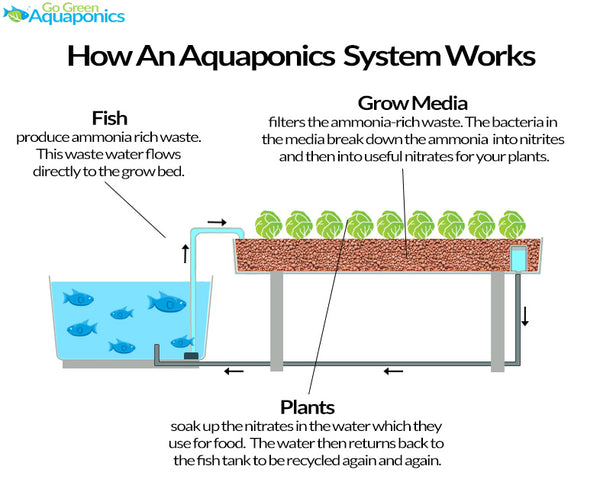
 

Media Based Aquaponics System InfographicFiltration

The grow media can serve as very efficient filters for mechanical and biological filtration in a media-based aquaponics system. The media-based system utilizes the combination of filters for the water and plant growing area for the plants. In addition, it also provides a place for mineralization to occur. However, high stocking densities can overwhelm the mechanical filtration that can risk having the media clogged and producing dangerous anaerobic spots. 

  • Mechanical Filter

The grow media functions as a large filter, capturing and containing the solid fish wastes, and other floating debris. The captured solid wastes will break down over time and be mineralized. A properly balanced media-based aquaponics system will process all the solid wastes. When the grow bed and grow media are not appropriately sized for the stocking density, the grow bed can be clogged with solids. To avoid clogging, be sure that the stocking density, feeding ratio, and feed rate are in the right ratio.

  •   Biological Filtration

Of all aquaponics methods, the media-based system has the most biological filtration because of the growing media's presence on which the bacteria can grow. However, the biofiltration capacity will be lost or limited if the grow bed and grow media become anoxic if the temperatures drop or if the water quality is low.

The Three Zones Of Media-Based Aquaponics System

There are three grow bed zones in the media-based aquaponics system, and each zone has different functions in the system.

Zone 1 - The Surface or Dry Zone. This area is within the first 1- 2" (5cm) of the grow bed. This area is called the dry zone and functions as a light barrier, preventing the light from hitting the water directly, which can lead to algae growth. This zone prevents the growth of fungus and other harmful bacteria at the base of the plant stem. The beneficial bacteria are sensitive to direct sunlight, and this zone also helps minimize evaporation from the beds by covering the wet zone from the direct light. 

Zone 2 - The root zone. This is where the plants' roots grow and where all pants activity takes place. Zone 2 is around the 4 - 6" (10-15cm) area of the grow bed and is the area that is regularly flooded and drained. 

For the flood and drain cycle, the incoming water helps spread moisture, nutrients, and incoming solid fish waste particles into the area. When it's time for the flood and drain cycle, the drain parts allow the water to drain away completely. This draining allows for the efficient delivery of the oxygen-rich air into the plants' root area.

If not using a flood and drain technique, this zone is where the water flows through the medium. In this zone, the worms are responsible for breaking down and minimizing solid waste, which releases nutrients throughout the system. 

Zone 3- The solid collection and mineralization zone. This is the last zone which is in the last 2" (5cm) of the grow bed that remains permanently wet. In this zone, the small solid wastes accumulate, so the organisms that are the most active in mineralization are located here. These organisms break down the waste into smaller fractions and molecules that can be absorbed by the plants through the process of mineralization. 

Advantages And Disadvantages Of Media-Based System

Advantages

  • Relatively simple and inexpensive.
  • Suitable for all kinds of plants, from leafy greens to larger fruiting plants.
  • Minimal cleaning is required.
  • For a further breakdown of fish waste, red worms can be added to the gravel bed.
  • The media perform a filtering action, preventing debris from returning to the tank.
  • The air is present between media particles, supplying oxygen to the roots.
  • Suitable for hobby applications, home gardens, and as part of the commercial farm. 

Disadvantages

  • A good-quality medium can be relatively expensive.
  • The pore spaces in the medium may get clogged over time, causing anaerobic conditions that are poor for your plants.
  • It can require cleaning of the grow bed.
  • By itself, this style system is not usually suitable for commercial purposes due to lower productivity and difficulty in a large-scale implementation.
  • The media beds are heavy and need a strong, rigid structure.

Components of a Media Based Aquaponics System

It is important to have materials comfortable for the farmer. The ultimate aquaponics beginner’s guide discusses all the necessary materials needed in setting up an aquaponics system. These are the essential criteria for the materials that will be used in the media-based system. 

  • Grow media must have a large surface area for bacterial growth.
  • Materials must be neutral pH and inert (non-toxic).
  • Must have good drainage properties.
  • Easy to work with.
  • Sufficient space for air and water to flow within the medium.
  •  Durable and cost-effective.
  • Lightweight

1. Fish Tank 

Fish tanks are a critical component of aquaponics. Fish require specific conditions to thrive and survive. Therefore, the fish tank should be chosen wisely. There are important aspects that need to be considered in choosing your fish tank.

  • Shape

Although any tank's shape will work, round tanks with flat bottoms are recommended for aquaponics. A round shape tank allows water to circulate uniformly and transports solid wastes towards the tank's center. Square tank with flat bottom works, but it requires active solid waste removal. Tank shapes affect water circulation, and it's risky to have a tank with poor circulation. Artistically shaped tanks with many curves and bends can create dead sp[ots in the water with no circulation. These areas gather wastes and create dangerous anoxic conditions for the fish. It is important to choose a tank that fits the characteristics of the aquatic species reared because many species of bottom-dwelling fish show better growth and less stress with adequate horizontal space.

  • Material

The material should be either a strong, inert plastic or fiberglass because of their durability and long life span. Plastic and fiberglass are easy to install for plumbing and are fairly light. Metal is not advisable because of rust. If you're using a plastic container, make sure that they are food-grade and UV-resistant because direct sunlight can destroy the plastic. 

  • Color

White or other light-colored fish tanks are advisable because they allow easy viewing of the fish inside the tanks. White tanks also reflect the sunlight and keep the water cool. 

Grow Media in an Aquaponics System

2. Grow Bed

One of the most important components in the media bed system is the grow bed. The grow bed is where you grow your plants. Make sure your grow bed is:

  • made of food-grade materials that will not leak unwanted chemicals into the water or affect the water pH. 
  • Strong enough to hold the water and growing media.
  • Able to withstand different weather conditions.
  • It can be connected to other components easily through simple plumbing parts.
  • It can be placed near the other components.

Shape

The standard shape for a media bed is a rectangle. Large grow beds can be used, but they require support to hold their weight. However, the grow beds should not be so wide that the farmer/ operator cannot reach across, at least half-way.

Depth and Size 

A media-based grow bed needs to have the right depth and size related to the fish volume and provide adequate filtration for the nutrient-rich water. The grow bed depth is important because it determines what types of vegetables can be grown. 

Grow beds should be about 12 inches in depth to optimize plant growth and for the cultivation of beneficial ecosystems in the bed. When selecting your grow bed, the rule of thumb is to use a 1:1 ratio of your grow bed to the fish tank in small systems. This means that the grow bed volume should be equal to the fish tank volume. This is not a hard rule but a good rule to follow when starting out.

3. Grow Media

Many materials can be used as a medium in a media-based system. However, the media must be organic and have an adequate surface area to allow bacteria to grow and water to flow to the plants' roots. The medium must have a neutral pH so that the water quality will not be affected. It is good to wash the media thoroughly before placing it into your grow bed to ensure that there are no dangerous particles that can potentially harm the fish.

Grow Media Options

Gravel

It is the least expensive and most readily available grow medium, ¾" gravel is best for supporting taller plants, and it doesn't get clogged like smaller pea gravel. Gravel thought is heavy and is not as preferred for growing smaller plants because it can be rough on the hands. Another drawback of using gravel is that it does not hold water efficiently, so it can sometimes be more difficult to colonize the needed bacteria in your system. It is important to perform a vinegar test of gravel before placing it in your system, as limestone is sometimes present in the gravel.

Clay pebbles

 LECA (Lightweight Expanded Clay Aggregate) are balls of clay processed at a very high temperature to form a highly effective growing medium. Clay pebbles are lightweight enough to move around when planting easily and heavy enough to provide adequate support for small to medium plants. (you may need to support/tie-up tall plants like corn, for example) They are also non-degradable, non-toxic, and pH neutral. Clay pebbles are more expensive compared to the other mediums, but because it is reusable, lightweight, and pH neutral; clay pebbles are an investment that will last for many years.

Lava Rock

 The naturally created lava rock cools rapidly, which gives no time for the air to escape, effectively trapping it. This trapped air creates a highly porous surface, increasing the area of the rock and creating plenty of openings for the nitrifying bacteria to live. Lava rock is light and has a neutral pH, so it won't affect the balance of your system. Lava rock can be sharp, though, so you will want to use it with caution.

4. Bell Siphon

A Bell Siphon, also known as an Auto Siphon, is a mechanical device used to regulate the water flow quickly and efficiently in an aquaponic system. The siphon automatically allows water from the grow bed to be drained into the fish tank. Then the water is pumped from the fish tank into the grow bed. The siphon also maintains a minimum water level and drains any excess water.

    Bell Peppers Growing in Aquaponics

    Best Plants To Grow In Media Based Aquaponics System

    Vegetables have different nutrient demand. In aquaponics, plants are categorized based on their nutrient demand. 

    1. Low-nutrient-demand plants include leafy greens and herbs like chard, lettuce, basil, mint, chives, parsley, coriander, pak choy, watercress, and legumes such as peas and beans.
    2. Medium-nutrient demand plants are cabbage, kale, cauliflower, broccoli, onions, carrots, and taro.
    3. High-nutrient-demand plants, also called nutrient hungry plants, are tomatoes, eggplants, cucumbers, strawberries, and peppers.

    Your choice of plants will depend on the style of your grow bed. Our article What Are The Best Plants For Aquaponics discusses what plants grow best in an aquaponics system. In media-based aquaponics, it is possible to grow leafy greens, herbs, and fruiting vegetables at the same time, as long as the grow beds are the right depth. A media-based can also take advantage of mixed planting with better space management because shade-tolerant species can grow underneath taller plants. Large bulb and root crops, such as ginger, carrots, and turnips, are best grown in a media-based aquaponics system because the grow bed and grow media provide an excellent growing environment and adequate support to plants.

    Other Types of Aquaponics Systems

    The two other main types of aquaponic systems are Raft Systems, Nutrient Film Technique, or NFT.

    Raft System

    The raft system also is known as Deep Water Culture or Floating System. Plants are grown on rafts (polystyrene or foam boards) that float on top of the water in the raft tank. The nutrient-filled water flows continuously from the fish tank through the filtration process, then to the raft tank where the plants are grown, and then back to the fish tank. Most often, the raft tank is separate from the fish tank. Plants grow very fast in a raft system and can be an easy aquaponics system for the beginner aquaponics gardener to set up and maintain. 

    Since the development of aquaponics raft systems (DWC) on a commercial scale by Dr. Rakocy at the University of the Virgin Islands, many commercial aquaponics farms utilize this system because it allows the plants to grow faster and yield more crops. The Raft system is best suited for mass production of certain types of vegetables and leafy greens. 

    Nutrient Film Technique (NFT) System

    The Nutrient Film Technique (NFT) is an aquaponics method in which the plants are grown in a long narrow channel. NFT is both common in hydroponics and aquaponics due to its simple yet effective design. In NFT, a thin film of water flows continuously down each channel, providing the plant roots with water, nutrients, and oxygen. When the water reaches the end of the channel, it is pumped back to the fish tank. NFT uses both water and pumps to deliver nutrients to the plants, and the system requires a separate filter to clear the water of solids and biological waste before it's returned to the fish tank. This system is very efficient in its water use and is primarily used to cultivate greens with small roots systems. NFT is commonly used in the commercial aquaponic system but can also be used in a hobby system as long as it is filtered before it is used in NFT channels. 

    Conclusion

    Your choice of aquaponics system depends on you and what you want. We hope this article helps you make more informed about the media-based aquaponics system and decide which system is right for you. If you want to learn more, subscribe to our mailing list to be notified of our next article; What is the Nutrient Film Technique Aquaponics System


    Hydroponic Drip Systems. Simple DIY systems to set up. - luv2garden.com

    Hydroponic Drip Systems. Simple DIY systems to set up. - luv2garden.com

    Hydroponic Drip Systems. Simple DIY systems to set up.

    There are two basic types of hydroponic drip systems, Non-recirculating and recirculating [recovery drip systems]. Of course there are many variations of each type but theses are the 2 basic ones.

    The recirculating drip system reuses the nutrient solution. It is collected in a small reservoir and recirculated back over the media. Recirculating systems are considered to be more efficient by some in that it does not waste solution, but it has multiple drawbacks in comparison to simple drip systems.

    Hydroponic Drip Systems

    There are two basic types of hydroponic

    Comparison Hydroponic Recirculating and Non Recirculating Systems

    The pH and nutrient strengths fluctuate so need to be constantly monitored and frequently adjusted. Additional labor is required in maintaining the solution, be it adjusting pH and nutrient levels / strengths or periodic flushing to avoid mineral buildups and replenish nutrients.

    Non-recirculating drip systems are more common, and in my opinion the best way to go if you choose to use drip. Although water and solution is not reused in non recovery / non recirculating systems there is actually very little waste

    Precise timing of water cycles coupled with the correct medium assures that very little solution goes to waste. Allowing for a drip flow that wets the media without allowing for very much run off is the key. Once you get your system set up you’ll have to tweak it a tad to get the time / water / nutrient ratios adjusted to your particular circumstances.

    Smaller, multiple applications have proven to increase yield in most crops. Tomatoes for instance have increased yields of 8% to 12%. A Japanese study ‘Influence of single and multiple water application timings on yield and water use efficiency in tomato’ [See: Agricultural Water Management] demonstrated the effects multiple water applications ‘the DT was the best irrigation timing because it increases the tomato yield by 8% and 12%’.

    Cycle timers are not all that expensive and are used to precisely adjust the drip flow. Flushing the solution and growing media is still required periodically to avoid nutrient build up over time. [See: Water Timers ]

    The water in the reservoir also needs to agitated and moving to prevent heavier and lighter minerals from separating in which case the heavier ones will fall to the bottom and not be present in the drip delivery.

    Grow Medium

    A slow draining medium is needed, Perlite/vermiculite or Rockwool work well, Organic media such as peat or coconut coir also work but sometimes add to the issue of clogged drippers.

    Drip systems become clogged due to particles from nutrients and organic matter that build up in the emitters. Systems that use organic nutrients and media are more prone to clogging. A blend of Perlite and vermiculite works very well, some growers also blend it with coconut fiber [coco coir] or peat moss. Perlite is fairly inexpensive but doesn’t retain water that well. Vermiculite retains water so when blended with perlite the two complement one another and make good hydroponic media for drip systems. A drawback to perlite is that emits an unhealthy dust [to humans] that also contributes to drip clogging, some growers add additional filtering for this reason. Screening, mesh, durable porous geotextile fabric /cloth, that will allow for the flow of water and trap unwanted particles.

    mini pump hydroponics - Google Search

    mini pump hydroponics - Google Search

    Aquapro AP210 Tabletop Water Feature Pump - Bunnings Australia

    Aquapro AP210 Tabletop Water Feature Pump - Bunnings Australia


    Compare


    Aquapro
    Aquapro AP210 Tabletop Water Feature Pump

    No reviews yet

    I/N: 2810296


    $19.49

    Select your preferred purchase method
    In-StoreClick & CollectDelivery


    Find your item in store

    We think you're closest to our Windsor Gardens store

    Yes, check stock

    No, choose another store


    FeaturesDetailsGuides & DocumentsWarranty & ReturnsShop OnlineRatings & Reviews


    Features


    Ideal for small tabletop water features up to 25cm
    Compact, easy to hide out of sight
    Adjustable flow controller for the ideal water-flow
    2 year warranty for peace of mind
    The ultimate way to get your tabletop water feature up and running is to use the Aquapro AP210 pump. This pump is very small and compact allowing it hide snug, out of the way in any tabletop feature creating the complete harmonising and relaxing atmosphere.

    It comes with a flow controller so you can be in control of your desired water pressure. Suitable for water features up to 25cm high with up to 150 litre reservoir.

    Details


    Dimensions


                Width Height Length


    Product 45mm 40mm 30mm


    Package 140mm 130mm 150mm


    Weight


    Easy To CarryTotal Weight 0.36kg
    Specifications
    Colour
    Black
    Model Name
    AQUAPRO AP210 Tabletop Feature Pump
    Model Number
    02AS008
    Material
    N/A
    Volume
    0L
    Inlet / Outlet Size (mm)
    8

    Maximum Capacity (litres)
    210
    Submersible (Yes/No)
    Yes
    Indoor Use (Yes/No)
    Yes
    Adjustable Valve (Yes/No)
    Yes
    Outdoor Use (Yes/No)
    No
    Voltage
    240
    Flow (L)
    210
    Wattage
    2
    Maximum Flow (litres per hour)
    210
    Head Size (m) 6
    Cord Length (m)
    2
    Required Tubing Diameter (cm) 8


    Guides & Documents


    Documents


    View Document(1.98MB)


    Warranty & Returns


    2 Years

    We will gladly assist with returns and exchanges of this product in accordance with our returns and exchanges policy.
    Returns Policy

    Aquapro AP200LV Low Voltage Tabletop Feature Pump - Bunnings Australia

    Aquapro AP200LV Low Voltage Tabletop Feature Pump - Bunnings Australia


    Compare


    Aquapro
    Aquapro AP200LV Low Voltage Tabletop Feature Pump

    No reviews yet

    I/N: 2810161


    $23.49

    Features


    Low voltage allowing for completely safe installation around pets and children
    Ideal for small tabletop water features up to 25cm
    Adjustable flow controller for the ideal water flow
    Compact, easy to hide out of sight
    2 Year warranty for peace of mind
    The ultimate way to get your tabletop water feature up and running is to use the Aquapro AP200LV pump. This pump is very small and compact allowing it hide snug, out of the way in any tabletop feature creating the complete harmonising and relaxing atmosphere. It comes with a flow controller so you can be in control of your desired water pressure. Being a low voltage pump, it comes with a detachable transformer for ease of use and complete safety around children and pets. Suitable for water features up to 25cm high with up to 150 litre reservoir.

    Details


    Dimensions


    Width


    Height


    Length


    Product 40mm 50mm 37mm


    Package 155mm 130mm 140mm


    Weight


    Easy To CarryTotal Weight 0.22kg
    Specifications
    Colour
    Black
    Model Name
    AQUAPRO AP200LV Low Voltage Tabletop Feature Pump
    Model Number
    02AL106
    Material
    NA
    Inlet / Outlet Size (mm)
    8
    Maximum Capacity (litres)
    200
    Submersible (Yes/No)
    Yes
    Indoor Use (Yes/No)
    Yes
    Adjustable Valve (Yes/No)
    Yes
    Outdoor Use (Yes/No)
    No
    Voltage
    12
    Flow (L)
    200
    Wattage
    3
    Maximum Flow (litres per hour)
    200
    Head Size (m)
    6
    Cord Length (m)
    18
    Required Tubing Diameter (cm)
    8


    Guides & Documents


    Documents


    View Document


    Warranty & Returns


    꽃이 시든 후 난초를 돌보는 방법에 대한 동영상 요약

    Google Gemini 꽃이 시든 후 난초를 돌보는 방법에 대한 동영상 요약입니다. 개요 이 동영상은 꽃이 시든 후 난초를 돌보는 방법에 대한 팁을 공유하며, 특히 시들거나 약해진 난초를 되살리는 데 중점을 둡니다. [ 00:05 ] 이 과정에는 ...